You’ve got three seconds. Maybe less. That’s the brutal reality of social media advertising — your hoodie ad is competing with baby videos, memes, breaking news, and every brand on the planet. So what makes someone stop mid-scroll and actually look at what you’re selling?
It’s not always the discount. It’s not always the copy. More often than not, it’s the visual. And the visual starts with your mockup.
Why Mockups Beat Flat Lays in Paid Social
Flat lay photography has its place — editorial, lookbooks, mood boards. But on Facebook and Instagram ads? You need context. You need lifestyle. You need someone to look at your hoodie and think that could be me.
A well-crafted Hoodie mockup puts your design into a real-world setting without the cost of a full photoshoot. No model bookings. No studio rentals. No retouching budget. Just your artwork dropped into a scene that tells a story.
And storytelling is exactly what stops the scroll.
The Psychology Behind Scroll-Stopping Creative
Instagram’s algorithm rewards engagement, and engagement starts with a pause. The human eye is wired to stop at:
- Faces and human forms — mockups featuring on-body or ghost-mannequin hoodies tap directly into this instinct
- Contrast and color — a bold hoodie against a minimal background creates instant visual tension
- Recognizable shapes — a hoodie silhouette is universally understood; it signals comfort, identity, belonging
When your ad creative speaks to those instincts within the first frame, you don’t need to shout. The image does the work.
Designing Your Ad Around the Mockup (Not the Other Way Around)
Most brands make a fundamental mistake: they design an ad, then drop in a mockup as an afterthought. Flip the process. Start with the mockup. Ask yourself — what angle communicates the product best? What background color makes the design pop? What mood do I want this ad to carry?
A front-facing mockup works beautifully for showcasing logo placement. A three-quarter angle gives depth and dimension. A lifestyle scene — hoodie draped over a chair, backpack nearby, coffee in frame — tells a whole story about who wears this piece and when.
Build your headline and CTA around what the image already communicates. If the mockup reads cozy autumn weekend, your copy should follow that energy.
Real Examples: Hoodie Mockups in Practice
Here’s where theory meets reality. These are the kinds of ad scenarios where mockups genuinely move the needle:
The Drop Campaign. A small streetwear brand launching a limited-edition hoodie used a dark-toned mockup with dramatic side lighting. The image ran as a single-image Facebook ad with just “24 hours. 50 pieces.” as copy. No discount. No long explanation. The mockup’s cinematic quality made the product feel exclusive before anyone even clicked.
The Color Variant Carousel. An e-commerce store selling custom hoodies created a carousel Instagram ad featuring the same design in six colorways — each on a matching-tone minimalist background. Because the mockups were consistent in style and angle, the carousel felt cohesive and editorial. CTR jumped compared to their previous product-photo ads.
The Print-on-Demand Launch. A creator launching merch for the first time had zero inventory and zero photos. They used a lifestyle mockup — hoodie folded casually on a wooden surface, warm light, clean composition — and ran it as a Story ad. The visual looked like it came from a real brand with a real studio. Their first drop sold out in 48 hours.
The Retargeting Refresh. Ad fatigue is real. One brand combated it by rotating three different mockup angles of the same hoodie across their retargeting campaign — front, back, folded flat. Same product, fresh creative every few days. Frequency stayed high, but fatigue dropped because the eye perceived something new each time.
What Makes a Mockup Work in Paid Social Specifically
Not all mockups are created equal, and social ads are unforgiving. A pixelated render or an awkward fabric shadow will tank trust instantly. Here’s what to look for:
- Resolution fit for feed and Stories — your mockup needs to look sharp at 1080×1080 and 1080×1920
- Neutral or controllable backgrounds — you need to be able to match your brand palette or add text overlays cleanly
- Realistic texture and shadow — authenticity is everything when you’re asking someone to hand over money
- Multiple angles in one pack — for carousel and A/B testing, variety is non-negotiable
Hoodie Mockups on ls.graphics: What Sets Them Apart
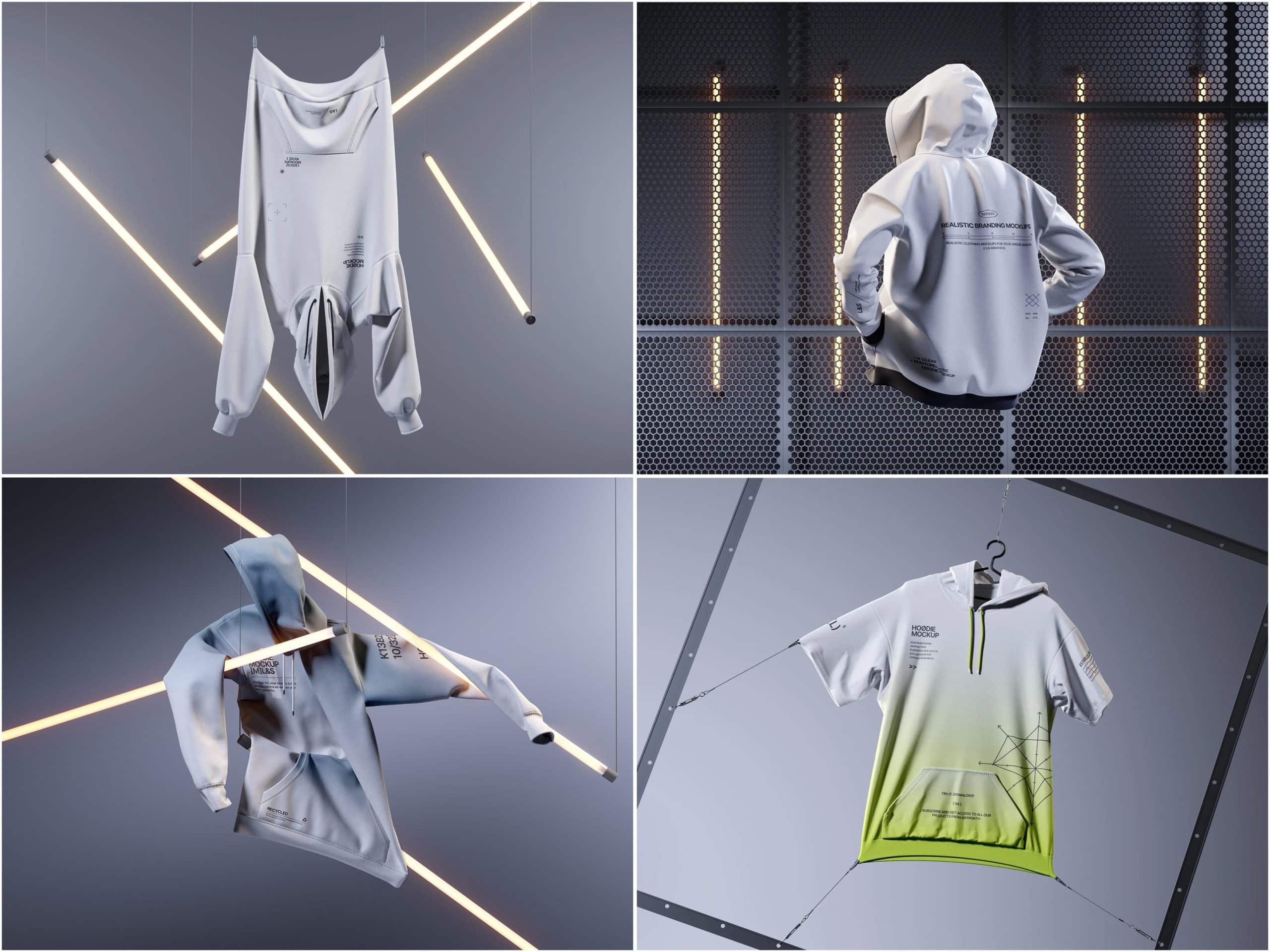
If you’re serious about ad creative, the source of your mockups matters enormously. ls.graphics has built a reputation for mockup quality that professionals actually rely on — and their hoodie collection reflects exactly why.
Every file features ultra-realistic rendering with genuine fabric texture, precise stitch detail, and natural light falloff — nothing like the blurry generics scattered across free resource sites. The organized layer structure lets you swap colors, adjust shadows, and place artwork cleanly without fighting the file.
The collection spans many different angles — front, back, folded, hanging, on-body — paired with stylish minimalistic compositions that look premium straight out of the box. The Edit Online feature removes the Photoshop barrier entirely: drop in your design, tweak colors, export ad-ready files from the browser. And a generous library of free scenes lets you test the quality before committing to the full collection.
Conclusion
Social ads are a visual-first medium, and your mockup is often the first — and most powerful — impression your brand makes. Done right, it doesn’t just show a product. It builds desire, signals quality, and earns the click.
The brands winning on Facebook and Instagram aren’t necessarily spending more. They’re just making smarter creative decisions earlier in the process. That starts with choosing visuals that look genuinely premium and translating them into ad formats built around how real humans scroll.
For anyone serious about elevating their hoodie brand’s ad performance, ls.graphics offers the kind of mockup quality that bridges the gap between startup and established brand — often in just a few clicks. The rest is great copy and a little courage to test.